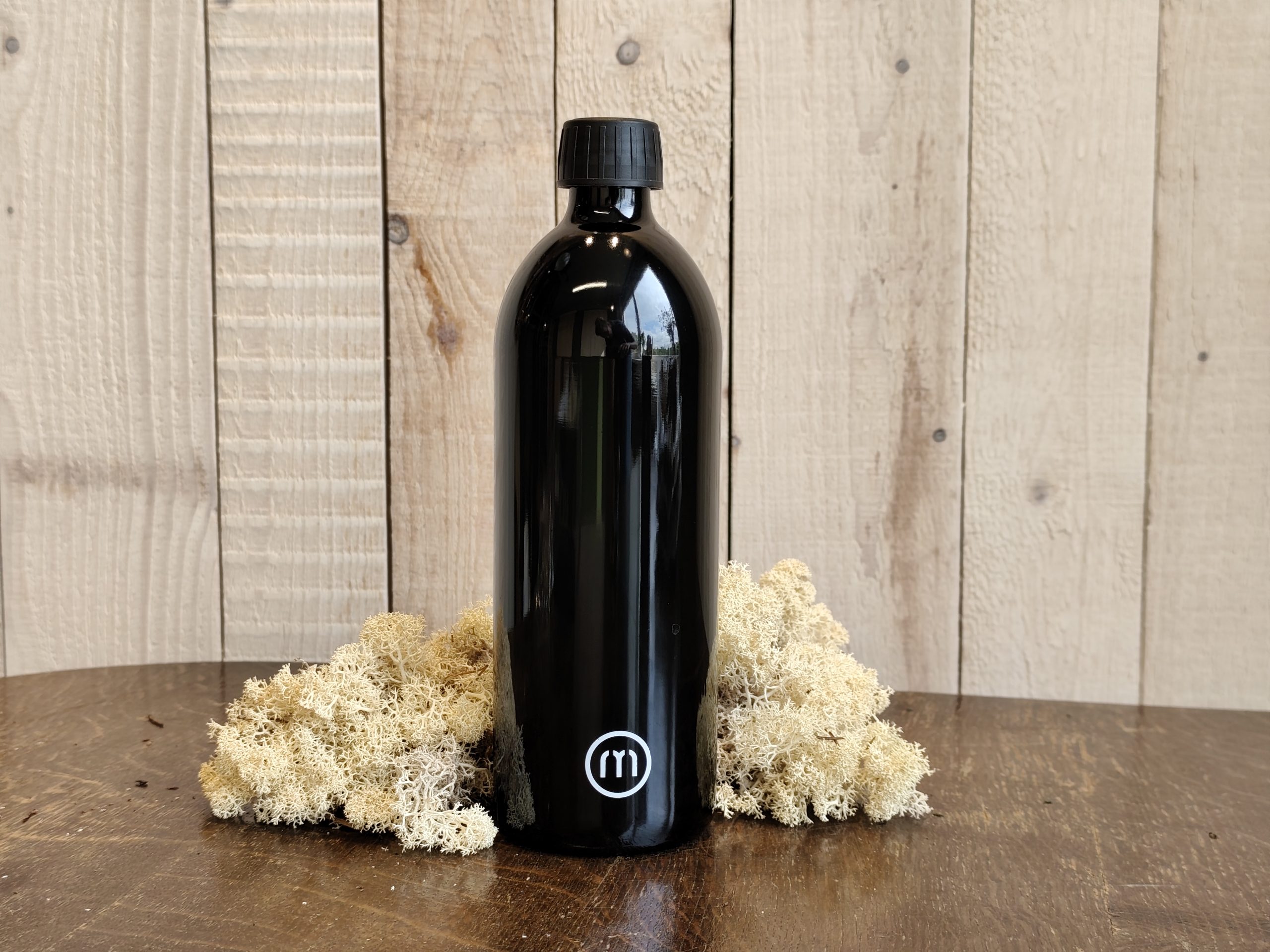
500 ml
Biophotons, the Light of Life, and the Mystery of Violet Glass
Life is not merely a combination of minerals, vitamins, fatty acids, or plant extracts. It has another, much more subtle layer: light.
Every living cell emits extremely weak light impulses known as biophotons. This is not ordinary light visible to the human eye. Rather, it is an ultra-weak emission of photons arising from living biological processes. Biophotons are associated with cellular metabolism, mitochondrial activity, oxidative processes, DNA activity, cell-to-cell communication, and the body’s internal organization.
In other words, biophotons can be seen as the radiance of life itself. They may be understood as one of the most subtle signs that a living process is still taking place within an organism, plant, food, or natural product. Where there is a high degree of biological order, this light remains harmonious. Where decay, oxidation, aging, or disorder begin, the light signal changes—or disappears altogether.
Biophotons as Carriers of Biological Information
These quanta of light may be involved in communication between cells. Cells are not isolated chemical containers. They constantly exchange signals, respond to their environment, adapt to rhythms, light, stress, nutrition, inflammation, and the body’s internal condition.
Biophotons may be viewed as a highly subtle informational language through which a living organism expresses its internal state. They are not merely light. They may reflect the level of oxidative stress within a cell, the activity of mitochondria, the body’s response to external influences, and the pace of biological aging.
For this reason, the study of biophotons has become especially interesting in fields such as health, food quality, plant extracts, natural oils, and water energetics. If a product is fresh, natural, and minimally altered, it possesses not only a chemical composition but also a subtle life potential. This potential may be described as light quality, biophotonic integrity, or energetic value.
Food, Plants, and Biophotonic Quality
Biophotons are important not only for the human body but also for food, plants, herbs, oils, extracts, honey, water, and natural products.
A fresh plant is alive. It grows under the sun, storing light, minerals, water, aromatic compounds, and beneficial phytochemicals. Once a plant is harvested, pressed, dried, or transformed into an extract, its living processes change. From that moment, a sensitive period begins: the product can either be preserved or allowed to gradually lose its vitality.
Light, oxygen, heat, and time are among the primary factors responsible for the degradation of natural products. Oils oxidize. Herbs lose their aroma. Pigments fade. Volatile compounds evaporate. Vitamins and polyphenols diminish. Water may lose some of its freshness and vitality on an energetic level, while delicate essences become progressively less vibrant.
The Sun: Source of Life and Accelerator of Degradation
The sun is one of the most important prerequisites for life on Earth. Without light, there would be no plants, photosynthesis, oxygen production, biological rhythms, vitamin D synthesis, vision, or countless other biological processes. Light is the architect of life.
At the same time, visible light, ultraviolet radiation, and heat can affect delicate plant-based substances. This is why ordinary clear glass often does not provide sufficient protection. It beautifully displays the product, yet it also allows light to continue its work—slowly degrading what was once alive.
Water and Its Subtle Structure
Water is more than the chemical formula H₂O. It is the medium in which nearly all life processes occur. Water transports minerals, information, heat, electrical impulses, and biological signals. Without water, cells could not communicate, move, cleanse themselves, or regenerate.
For this reason, many traditions have regarded water not merely as a liquid but also as a carrier of information. Water absorbs influences from its surroundings: light, temperature, movement, storage conditions, and the substances with which it comes into contact.
When water is stored in plastic, it remains in contact with a material that is not natural and may release odors, microplastic particles, or chemical residues. When water is stored in clear glass and exposed to light, it is not protected from environmental influences. When stored in high-quality violet glass, it exists in a different environment—protected, dark, stable, and filtered from excessive light exposure.
From an energetic perspective, such water may be perceived as being better protected from the disruptive effects of light. Some proponents suggest that it may retain more biophotons within its structure. Improved storage conditions may help preserve its purity and freshness. Many people report that water stored in glass—especially dark violet glass—feels softer, more vibrant, and more pleasant to drink.
Ancient Cultures and the Secret of Purple Vessels
Even in ancient cultures, valuable essences, oils, fragrances, ritual blends, and healing preparations were often stored in special containers. Gold, dark glass, violet, and purple were associated with protection, royalty, sacredness, and transformation.
Purple was never considered an ordinary color. It belonged to rulers, temples, alchemists, and objects that were meant to be set apart from everyday life. Symbolically, violet stands between earth and sky, matter and spirit, visible form and invisible energy.
For this reason, violet glass carries not only practical value but also symbolic significance. It quietly conveys the message: what is inside deserves protection.
Violet Glass as a Light Filter
Violet glass is far more than attractive packaging. Its primary function is optical protection.
Dark violet glass blocks much of the visible light spectrum that may contribute to product degradation, while still allowing certain portions of violet light, UV-A radiation, and infrared light to pass through. In this way, it acts as a natural light filter.
This distinction is important. Ordinary glass allows most light to pass through. Brown or green glass offers only partial protection. Violet glass creates a far more selective environment: it shields products from the most damaging portions of visible light while still permitting exposure to a subtle light spectrum.
High-quality violet glass is not simply coated with color on the outside. Its distinctive hue is created within the glass itself through the incorporation of specialized metal oxides during manufacturing. As a result, the protective properties are not superficial—they are embedded within the structure of the glass.
What Does Violet Glass Do for Products?
Violet glass helps protect what is sensitive.
It is particularly valuable for products containing plant extracts, essential oils, cold-pressed oils, hydrosols, cosmetics, medicinal herbs, honey, spices, grains, seeds, natural essences, fermented products, and water.
Stored in such containers, products may retain their aroma, color, freshness, flavor, structure, and the stability of active compounds for a longer period. In other words, violet glass does not “add magic”; rather, it helps preserve what is already valuable.
If a product contains delicate aromas, sensitive polyphenols, natural pigments, plant oils, or other light-sensitive substances, its quality depends greatly on storage conditions. Violet glass helps reduce light-induced degradation and may contribute to slowing the aging process of the product.